![AI [re]Generation](https://substackcdn.com/image/fetch/$s_!L6aZ!,w_120,h_120,c_fill,f_webp,q_auto:good,fl_progressive:steep/https%3A%2F%2Fsubstack-post-media.s3.amazonaws.com%2Fpublic%2Fimages%2Fd316565c-2791-4f13-a334-efcf2499510d_768x768.png)


For almost a year I have been writing around a word without ever saying it.
I wrote about the Barnacle Economy, about why efficiency alone never makes a system healthier, only faster. I started with Who Owns Fire(Part 1 of 6), about intelligence quietly becoming a thing you rent by the cup. I wrote that the real return on AI was never money. Every one of those pieces was circling the same point from a different altitude, and the name of this whole publication has been pointing at it the whole time, sitting there in a set of brackets I never really opened.
AI [re]Generation.
I thought the word in those brackets was sustainable. It isn’t. Or it is, but only the way “not dying” is a description of being alive.
So let me say the word clearly, define it properly, and then give you something you can actually do with it on Monday morning. Because in two days I am standing in front of a room to talk about this, and I would rather you read the argument than watch me perform it.
Before we start:
The [De]finition
Strip the noise away and there are only three things AI can do to any system it touches.
It can deplete it. Each cycle takes more out than it puts back. This is extractive AI, and it is the default, not because anyone is evil but because extraction is what happens when you optimise for a single number and let everything else pay the difference.
It can hold it level. Each cycle roughly breaks even. This is sustainable AI, and almost the entire “responsible AI” conversation aims here: do less harm, net to zero, offset what you burn. Great but still a ceiling disguised as a finish line…
It can leave it richer than it found it. Each cycle returns more than it takes, so the stock the system runs on grows over time. This is the one almost nobody is building for, and it’s the biggest miss we are experiencing which we also desperately need!
That third thing is the only one that earns the word: Regenerative AI
Regenerative AI is the practice of using AI so that ‘every cycle of use’ leaves the systems it touches richer than before, and reinvests the gains it produces into the world’s capacity to regenerate.
Regenerative AI is measurably, structurally better, on the way out than on the way in. And here’s whats incredible important to understand: there isn’t one system AI touches, there are three. And a practice only earns the word if it comes out net positive on all three at once. But it’s honestly not that hard to get there!
The first is ecological stock: carbon, water, land, the living world.
The second is cognitive stock: whether the humans using the tool get sharper or slowly hand their thinking away.
The third is economic stock: whether the surplus AI generates gets reinvested into more regenerative capacity, or just quietly pocketed as margin.
Most of what gets called “responsible AI” closes the loop on one of these and calls it a day. Regenerative AI closes all three, that’s the whole bar. It’s high, it’s good and it’s the only legacy you want to leave behind.
The [Bill] in full
I am not going to skip the uncomfortable number, because skipping it makes people like me sound like salesmen…
Three weeks ago the United Nations University put out a report (something the AI industry mostly avoids): it counted the water and the land, not just the carbon.
By 2030, on current trajectories, the data centres running AI are projected to consume 945 terawatt-hours of electricity, and their water footprint is projected at 9.3 trillion litres a year. To make that more comprehensive: that is the basic annual domestic water needs of all 1.3 billion people living in Sub-Saharan Africa.
Read that again slowly. The thirst of a machine, measured in human beings.
And the report’s most important finding is the one almost everyone misreads. We obsess over the carbon cost of training the big models. But once a model is deployed, training is the small part. Inference, the ordinary act of answering prompts, is eighty to ninety per cent of the energy. In other words, our usage of talking to an LLM is responsible for it.
“More efficient AI means more consumption of AI.”
That line is a paraphrase of the report’s director, Kaveh Madani, and it is the whole game because what he is describing, in plain language, is the exact mechanism I named in the Barnacle Economy. The economists call it the Jevons Paradox: make a resource cheaper to use, and total use goes up, not down, until the saving is swallowed whole. The UN is now using that same paradox as the case for the prosecution. Efficiency won’t save us, they say because the cheaper we make intelligence, the more of it we’ll burn.
They are right.
And this is the exact point where most impact founders I meet fold their arms and say: so we won’t use it.
The thing refusers get wrong
There’s a story most of us heard as children and then quietly stopped applying. A farmer has a goose that lays one golden egg a day. It is a good life. But a day comes when one egg a day is no longer fast enough, and the farmer does the rational thing, the efficient thing, the thing the spreadsheet recommends. He opens the goose to get all the eggs at once.

We all know how that ends. We learned the lesson at six and unlearned it by thirty because we built tools that made opening the goose feel like strategy.
Extraction is opening the goose.
Regeneration is the unglamorous discipline of keeping it alive, feeding it, and over years ending up with a flock.
Here is what I got wrong for a long time, and I’ll own it: I used to tell founders that the Jevons Paradox could “work in their favour.” It can’t. That framing is soft, and a sharp room would have caught me on it. Jevons doesn’t take sides. It is not an ally and it is not the enemy. It is an amplifier, and amplifiers are loyal to no one.
Point the amplifier at extraction and you get 9.3 trillion litres of water spent generating images nobody asked for. Point the same amplifier at regeneration, at restoration planning, at the measuring and verifying that makes a carbon project bankable, at the coordination that lets fifteen people do the work of fifty, and the multiplier runs the other way. Cheaper regeneration means more regeneration. The force is identical and the only variable is where you aim it at.
Which means refusal is not the clean choice it feels like. Refusing the fire does not put it out, it just hands it to the people who will point it at the goose.
[4] Kinds of Companies
Once you separate what a company does from how it uses AI, the whole landscape resolves into four corners, and you can find yourself on it in about ten seconds.
There’s the company with a neutral mission that uses AI carelessly, no reinvestment, no attention to what it does to its people. That’s the extractive default. It’s also exactly what the refusers are picturing when they say no, and they’re not wrong to fear it.
There’s the barnacle organisation, the climate fund or the ocean-restoration outfit, that runs its entire operation through ungoverned chat windows, burns tokens with no thought, lets its team’s judgment quietly atrophy, and reinvests nothing. Righteous mission, extractive practice. I call these the cobbler’s children: the cobbler whose own kids go barefoot. This corner is more common than anyone admits, and naming it is more useful than any case study.
Then there are the two corners worth being in.
The conscientious user: an ordinary business that uses AI well, protects its people’s thinking, and pays back part of what it gains to regenerative practises.
And the closed loop: a regenerative company that turns AI on its own mission and uses the amplifier to grow demand for the thing the world actually needs more of: trees, corals, mangroves,….
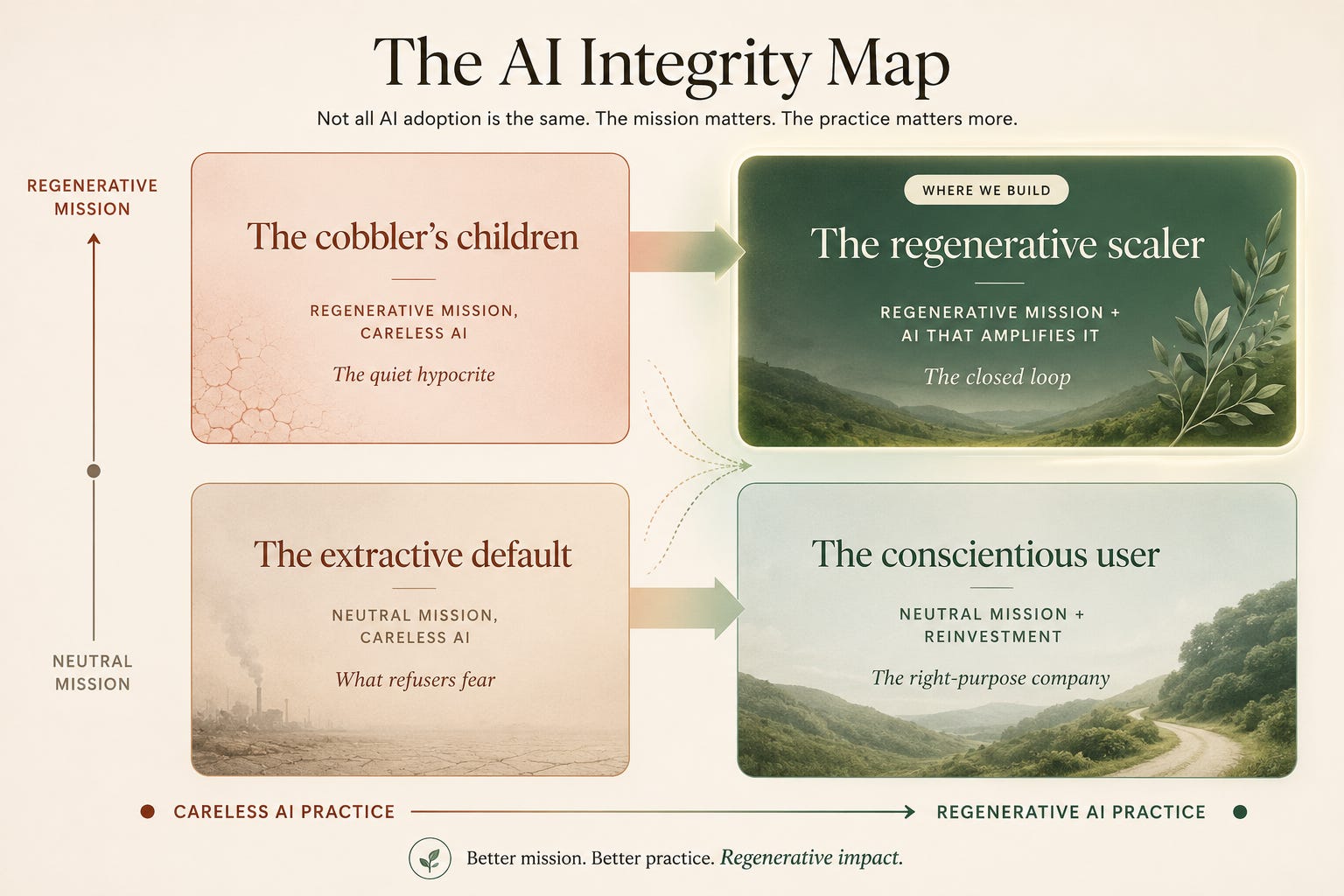
You don’t argue your way into the right corner. You build your way there. And the bridge between them has a name I keep coming back to, the control valve, and it’s the one step almost everyone skips.
[The] control valve
Here is the trap. You bring in AI, you save your team forty per cent of their time, and then, without deciding to, you take on forty per cent more clients at exactly the same rate of extraction. You have created precisely zero regeneration. You’ve just made the treadmill faster. The gain evaporates back into throughput, and Jevons wins again, quietly, inside your own company.
The reinvestment step is not decoration. It is the valve that converts an efficiency saving into regeneration instead of into more speed. If you take one thing from this entire piece, take this: a gain you don’t deliberately redirect will default to extraction every single time.
That’s the difference between a company that uses AI for the right reasons and a regenerative company. The first reinvests its gains so the goose stays healthy.
The second points the whole amplifier at hatching more geese.
You want, eventually, to be doing both. The loop only closes when the output of regeneration funds the tools that drive more regeneration, and the thing spins up instead of grinding down.
[So] what do you actually do?
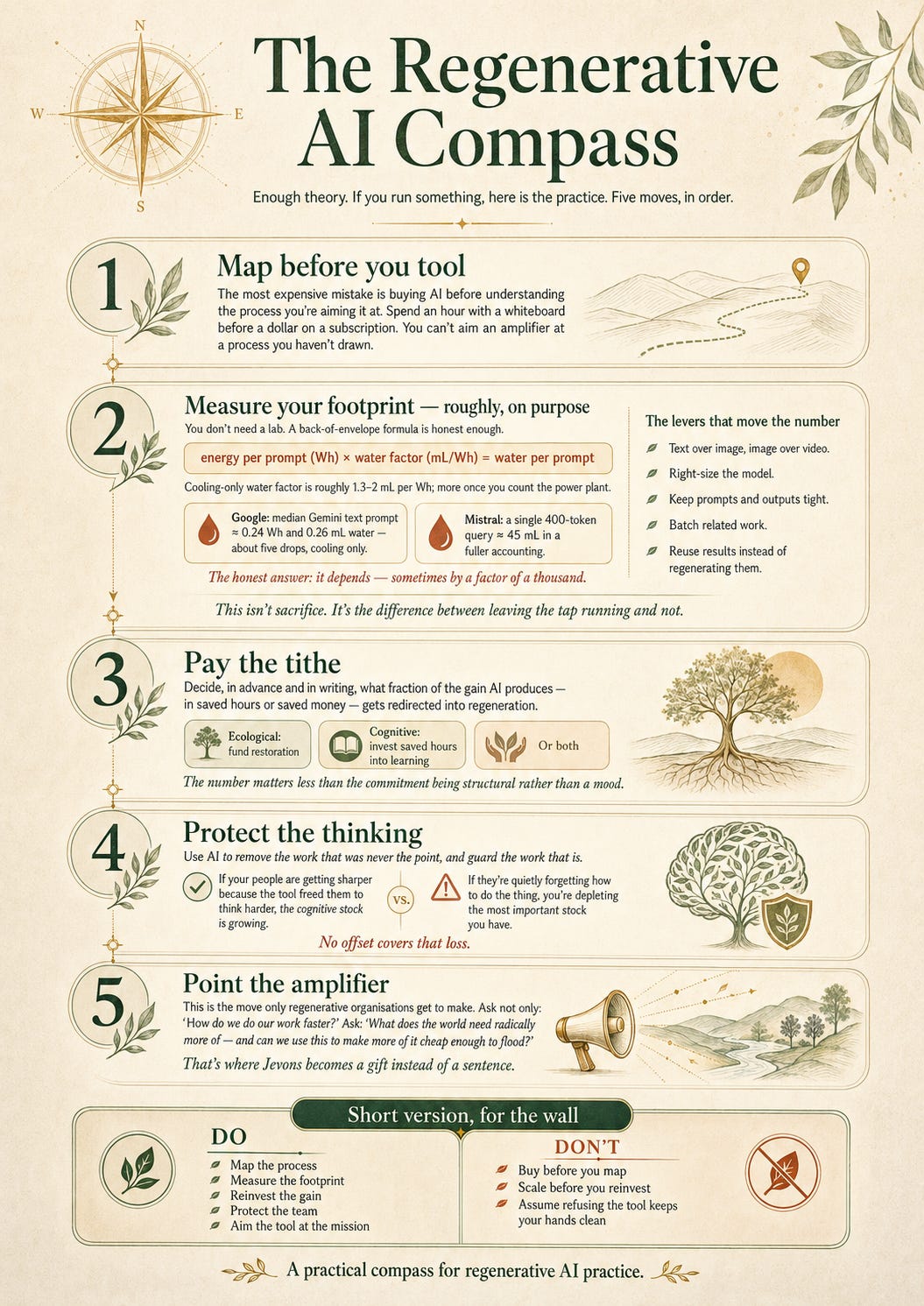
Enough theory. If you run something, here is the practice. Five moves, in order.
1. Map before you tool. The most expensive mistake I see is buying AI before understanding the process you’re aiming it at. An hour with a whiteboard before a dollar on a subscription. You can’t aim an amplifier at a process you haven’t drawn.
2. Measure your footprint, roughly, on purpose. You don’t need a lab. The back-of-envelope formula is honest enough:
energy per prompt (watt-hours) × water factor (millilitres per watt-hour) = water per prompt
The water factor sits somewhere between roughly 1.3 and 2 millilitres per watt-hour for cooling alone, more once you count the power plant. The spread in real figures is enormous and worth knowing: Google measured a median Gemini text prompt at about 0.24 watt-hours and 0.26 millilitres of water, roughly five drops, counting cooling only. Mistral, counting the fuller picture, put a single 400-token query at about 45 millilitres. The honest answer to “how much water does a prompt cost” is it depends by a factor of a thousand, and the things it depends on are choices you control.
Which leads to the levers that actually move the number:
Text over image, image over video. A single generated image runs on the order of a thousand-plus times the energy of a simple text task; video is far worse again.
Right-size the model. Don’t send a haiku to a frontier reasoning model.
Keep prompts and outputs tight. Batch related work. Reuse results instead of regenerating them.
None of this is sacrifice. It’s the difference between leaving the tap running and not.
3. Pay the tithe. Decide, in advance and in writing, what fraction of the gain AI produces, in saved hours or saved money, gets redirected into regeneration. It can be ecological (you fund restoration), cognitive (you put the saved hours into your team learning, not into more output), or both. The number matters less than the commitment being structural rather than a mood.
4. Protect the thinking. Use AI to remove the work that was never the point, and guard the work that is. If your people are getting sharper because the tool freed them to think harder, the cognitive stock is growing. If they’re quietly forgetting how to do the thing, you’re depleting the most important stock you have, and no offset covers that one.
5. Point the amplifier. This is the move only regenerative organisations get to make. Ask the real question: not “how do we do our work faster,” but “what does the world need radically more of, and can we use this to make more of it cheap enough to flood?” That’s where Jevons becomes a gift instead of a sentence.
A short version, for the wall:
Do map the process, measure the footprint, reinvest the gain, protect the team, aim the tool at the mission.
Don’t buy before you map, scale before you reinvest, or assume refusing the tool keeps your hands clean.
[What] I can’t answer you
I genuinely don’t know yet whether we’ll choose to aim the amplifier well at the scale this needs. The optimism and the worry sit in me at the same time and refuse to resolve, which is probably the honest state to be in about something this size.
But the choice doesn’t live at the scale of civilisation. It lives in your next subscription, your next process, your next decision about where the saved hour goes.
So here’s the only question worth leaving you with:
The next time AI saves your organisation an hour, who decides what that hour is for? And have you decided it on purpose, or will the treadmill decide it for you?
YOUR TO DO: This week, find one process AI already touches in your work. Map where the gain goes. If the answer is “back into more of the same”, you’ve found your first goose. Tell me what you do with it, reply to this email or find me at elevai.cc.
Wishing you a week where something you build leaves more behind than it takes.
Arthur
Regenerative AI practitioner
LinkedIn | ElevAI: teams of 15 doing the work of 50, on purpose
▸ END MATTER
If this shifted something, hit restack. Somewhere in your network is a founder who is about to make their team faster without ever deciding what the speed is for, and forty minutes with this might change the build.
I’m Arthur. I co-founded ElevAI, where we build AI infrastructure for impact organisations, the ones doing the work of 50 with a team of 15. Most of what I write here comes straight out of those rooms. If you’re building something that matters and want to make sure AI is actually helping, you know where to find me.
Reply to this email. I read every one.
I really enjoyed this.
Reading this through a systems-thinking lens, one thought stood out to me: AI isn't the strategy. It's an amplifier.
In digital business transformation, my guiding principle has always been: people and processes first, then technology. Once we truly understand the system we're trying to improve, AI becomes a powerful amplifier. Without that foundation, we often end up accelerating existing inefficiencies instead of creating better outcomes.